Dear Readers,
I’m excited to make my first post here on Books We Read, especially in October, which we recognize as Disability Awareness Month here at Rutgers.
First, a disclosure: I do not identify as a disabled person. In many ways, I’m a prime suspect in the need for disability awareness among non-disabled people. Reading and personal relationships have helped me become more aware of the challenges people with disabilities face in society and advocate for policies that help move us forward in accessibility. In my own story, two books were pivotal in introducing me to issues in disability justice.
The first is a children’s book: Petey, by Ben Mikaelsen, a novel about a man with cerebral palsy. Although I read the book in elementary school, I can distinctly remember not only Petey’s struggles to communicate with those around him and the frustration of his isolation, but also the richness of his interior life.
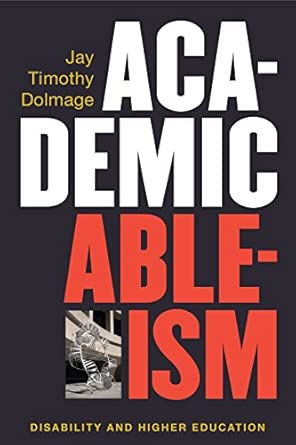 The second is a book that activated my participation in disability awareness and justice: Jay Dolmage’s Academic Ableism: Disability and Higher Education, the selection for a general DEI book club that I facilitated at Rowan University five years ago. While Petey elicited empathy as a young child, Academic Ableism lifted the veil on the ways that higher education has been complicit in the subjugation of people with disabilities through its ideologies, structures, and historical support for eugenics. It was the lessons learned through Dolmage’s critique that bolstered me to engage my colleagues about exhibiting disability-related items without proper context and led me to join the Rutgers, New Brunswick Disability Awareness Month Committee.
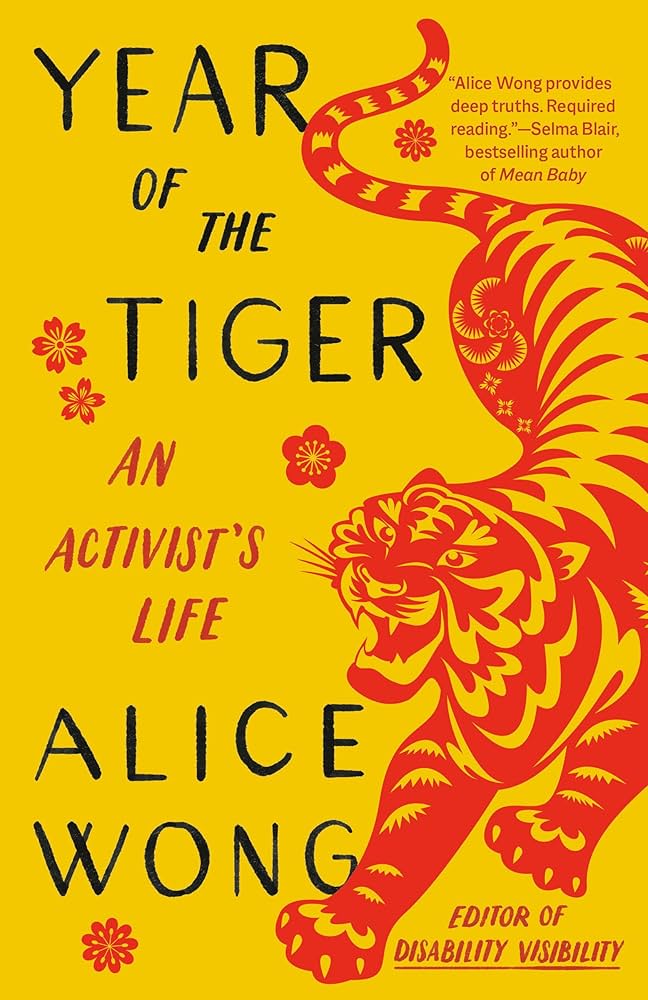
This year, I’ve added another book to my arsenal: Year of the Tiger: An Activist’s Life by Alice Wong. Wong is a well-known and outspoken activist for disability justice, and this book collects her work into a semi-biography. Wong’s voice (irreverent, cheeky, cool yet impassioned) makes the book a pleasure to read as she narrates not just the challenges she’s faced in an able-bodied society, but also the joys of living a full life grounded in friendship, community, and family. Included are essays and transcripts of podcast interviews, artwork, blog posts, twitter feeds, photographs, and more.
Beyond the format, this is not your typical disability memoir. As Wong writes in her introduction: “This is not a ‘harrowing’ yet ‘triumphant’ account of discrimination, ableism, humiliation, and pain. I’ve got a bunch of these stories, and you’re going to only get a sliver. I will not excavate my innermost secrets and traumas for your consumption. A memoir can provide only a glimpse of a person, and I am presenting one that is framed by me for nefarious purposes that you may discover one day if you dare.” (xvii) For me, those nefarious purposes are to make you not only rethink several narratives around disability, but also to activate you to get involved in justice-oriented work. It’s hard to give an overview of such a wide-ranging memoir that touches on issues of activism, access, culture, storytelling, perspectives from the pandemic, and the future of disability, but I’ll mention a few things that stood out to me.
 One of the issues that I hadn’t considered extensively until reading Wong’s work was the intertwinement of technology and simply living. Because of Wong’s disability, she relies on many machines to make activities accessible, including a power-chair and BiPap machine, and she even attended an event at the White House using a telepresence robot. Wong often calls herself a cyborg, and she looks forward to a post-robot world, something I personally dread. Wong envisions the future like Star Trek, but I’m afraid of The Matrix. However, I can understand the greater accessibility that comes with technology and can welcome newer mandates, including those coming this spring with changes to the ADA. Wong points out, however, that technology is never neutral, arguing for systematic changes, such as net neutrality to ensure equal access. When scarcity is built-in to technologies, people with disabilities can also become very vulnerable to corporations, such as when Wong’s BiPap machine had a health-threatening defect, but couldn’t be recalled as there was no alternative device. The machine is both saving her life and harming her health. Assistive devices also don’t necessarily need to be high-tech. Wong’s “Ode to a Spit Cup” is both hilarious and enlightening and I will never look at a plastic straw the same way after her diatribe on “The Last Straw,” where the conflict between equal access for people with disabilities and environmentalism come to an impasse.
The other conversation that made me pause was about the future of disability in a world with technologies like gene editing. Throughout the book, Wong discusses the value of people with disabilities: the creativity that people with disabilities bring from having to navigate a world not built for them, but, more importantly, the inherent value of human life, including people with disabilities. Eugenics and disabilities have always been intertwined, and we must consider the consequences of choosing the “best” genetic material to pass on, what might result in cultural genocide. At what point is a “cure” actually the acknowledgement that people with disabilities shouldn’t exist?
Activism is what put Wong on the map, and you can see how crucial storytelling is to that activism. Wong is a great storyteller; she knows how to get the reader hooked through her voice and makes you think about so many intersecting issues. Her stories of growing up in a Chinese immigrant family in Indiana are heartwarming, and she illuminates how her parents navigated cultural change with accommodating Wong’s evolving medical needs. Wong’s perspective is also valuable as she was on the front lines of accessible education, going through the implementation of the ADA while in high school. She saw the changes that systematic approaches can make, but also their flaws and the work that still must be done. She is an indispensable voice in so many forums on so many topics, and Year of the Tiger is a great introduction to disability justice and advocacy.