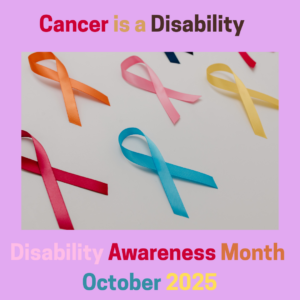
 October is Disability Awareness Month, and it’s a great time to talk about something that, in our experience, many people don’t realize: cancer can be considered a disability under the Americans with Disabilities Act (ADA). Whether someone is newly diagnosed, in treatment, or in remission, the ADA offers support and protection. Knowing and understanding them can make a big difference.
The Office of Disability Services (ODS) at Rutgers is here to help. Based on the ADA, students are entitled to reasonable accommodations, privacy, and protection from harassment. Support includes access to facilities, exemption from risky activities, and respectful treatment by faculty and staff. Let’s break it down.
Wait, cancer is a disability?
Yes, it can be. As a federal civil rights law, the ADA defines a disability as a physical or mental impairment that substantially limits one or more major life activities, which includes walking, concentrating, and even normal cell growth, which is directly affected by cancer. The ADA also protects people who have a history or record of an impairment, such as people with cancer in remission. If someone is treated unfairly because of their diagnosis, or even because someone thinks they have cancer, that’s discrimination, which is illegal.
What does this mean in real life?
If you are going to school with cancer
As an example, if a college student is recovering from cancer and still experiences fatigue or cognitive challenges due to treatment, they may be eligible for time-related academic accommodations such as extended test time, flexible deadlines, or even reduced course load. Modified attendance policies, such as make-up exams or alternative testing arrangements, allow for treatment-related absences. Remote participation options include Zoom classes and recorded lectures, to name a few.
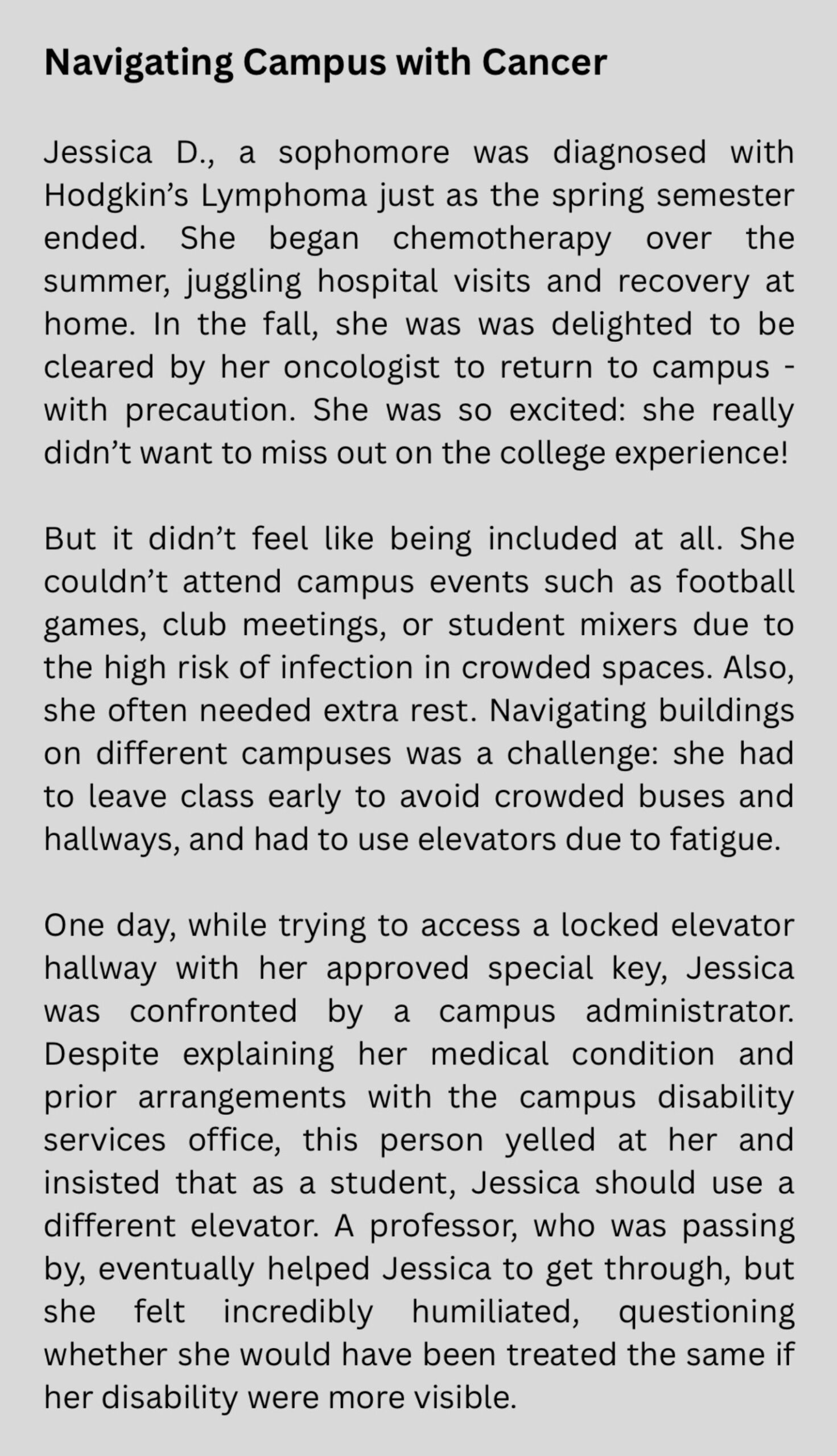
This story highlights challenges faced by students with invisible disabilities like cancer.
1. Registering with ODS
At Rutgers, students must register with ODS to access accommodations either by meeting with a coordinator to discuss their needs (traditional option), or, students who already know what accommodations they need also have a fast track option.
You will have to present medical documentation that verifies your disability. This may include the original diagnosis, how it affects major life activities (e.g., concentration, mobility), and its impact on academic performance.
2. Requesting a Letter of Accommodation (LOA)
Once approved, you have to request a Letter of Accommodation that outlines the approved accommodations through a Letter of Accommodations Request Form. You must request this letter each semester.
This letter will be sent to the student and their professor. See more details, including a sample email template.
3. Communicating with the professors
Nevertheless, you may want to share your LOA with your instructors early in the semester. Various types of accommodations include, among others:
- Exam accommodation
- Note-taking accommodation
- Accessible Course Materials (ACM) / Alternate Format Text (AFT)
If you are working or applying for a job
Let’s say you’re a student working part-time in the library. You’ve just started chemotherapy and need to adjust your hours. Under the ADA, you can request a reasonable accommodation, such as a modified schedule or an extra break. How do you do it?
When you let your employer know that you need an adjustment, you do not need to use the specific legal term “reasonable accommodation” or mention the ADA, just that it’s for a reason related to a medical condition. In most cases, you do not need to provide a formal written request, though it can be helpful for record-keeping. Note that your employer is not required to give you exactly what you ask for, but they do have to work with you.
If you’re applying for a job and worried about disclosing your diagnosis, we have good news: employers can’t ask if you have or have had cancer before making a job offer. You’re not required to tell them either.
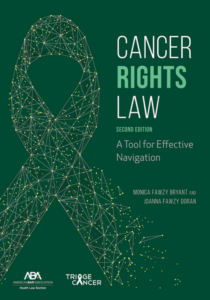 Book Spotlight: Cancer Rights Law
If this all sounds overwhelming, don’t worry. There’s a book that makes it a bit easier: Cancer Rights Law: A Tool for Effective Navigation, by Monica Fawzy Bryant and Joanna Fawzy Doran, a must-read for anyone affected by cancer. It covers a lot more than students and their loved ones need to know and can be used as a reference book or textbook.
- Employment rights under the ADA
- Health and disability insurance
- Medical decision-making and estate planning
- Financial resources
Written by two attorneys who co-founded a free educational resource on cancer law called Triage Cancer, the book addresses legal topics from the perspective of a cancer diagnosis. It’s also perfect for students studying law, public health, or anyone who wants to support a friend or family member.
Why we think this matters on campus
Unfortunately, college students, despite their young age, aren’t immune to cancer. Some are survivors. Some will be newly diagnosed. Some are caregivers. Some are just trying to support a friend. We strongly believe that understanding how the ADA applies to cancer helps create a more inclusive, empathetic campus.
Here’s what you can do:
- Know your rights: whether you’re studying, working, or supporting someone with cancer, knowledge is power.
- Speak up: if you see discrimination or harassment, say something.
- Find and share resources: reach out to the Office of Disabilities, look up information on a trusted website, or check out some books from the library.
Final thoughts
Disabilities Awareness Month highlights the importance of recognizing all kinds of challenges and getting familiar with the laws that may help people overcome them. Cancer may not always be visible, but its impact is real. Thanks to the ADA, people with cancer also have rights. And thanks to books like Cancer Rights Law, those rights are easier to understand and use.
So next time you hear someone say, “I didn’t know cancer was a disability,” you’ll know what to say. And maybe you’ll even point them to a book that could help them in difficult times or even change their life.
Government resources: the most current information
- Cancer in the Workplace and the ADA – Detailed, cancer-specific information from the U.S. Equal Employment Opportunity Commission, with examples.
- Workplace protection for Individuals Impacted by Cancer – Information from the U.S. Department of Labor about taking time off from work and protection against discrimination.
- Family and Medical Leave Act – Definition, interpretation, and worksheets from the U.S. Department of Labor.
- Reasonable accommodations in the workplace – A fact sheet with a basic overview of reasonable accommodations in the workplace from ADA National Network. It includes examples and a brief review of the reasonable accommodation process.
Read more from Rutgers University Libraries
- Agnew, L. P. (2024). Fitter, Happier : The Eugenic Strain in Twentieth-Century Cancer Rhetoric. The University of Alabama Press. – Online.
Examines the complexity of public language about cancer, with a particular focus on the historical evolution of US cancer rhetoric during the twentieth century. - Bryant, M. F., Doran, J. F., American Bar Association. Health Law Section, issuing body, & Triage Cancer, issuing body. (2025). Cancer rights law: a tool for effective navigation. American Bar Association, Health Law Section. – Print.
Provides an overview of key areas of the law that often come into play for individuals who have been diagnosed with cancer and their caregivers, including health insurance, employment, disability insurance, genetics, estate planning and medical decision making, and finances and consumer right. 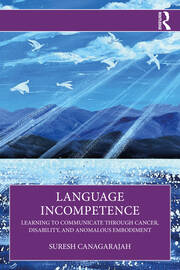 Canagarajah, A. S. (2022). Language incompetence : learning to communicate through cancer, disability, and anomalous embodiment. Routledge. – Online.
Helps understand what language studies can offer to address the role of disabilities, impairments, and debilities in embodied communication and thinking.- Rasmussen, A. J., & Sodemann, M. (2024). Narrative medicine. Vernon Art and Science Inc. – Online.
Addresses creating ethical storytelling spaces for those living with trauma and disability, and examines narrative methods in trauma care. - Smartt Gullion, Barber, D., & Bones, P. D. C. (Eds.). (2022). Redefining disability. Brill. – Online.
Challenges the outsider-dominated approach to disability by centering the disabled experience. Addresses disability and race, sexuality and disability, disability cultures, accommodation, self-diagnosis, and how we manage the obstacles ableist institutions place in our way.