As your friendly neighborhood librarian, I must remind you: stack your bedside books carefully. Your nightstand is essentially a tiny public library you operate in your sleep, and if you don’t wake up, trust me, people will absolutely judge the collection.
So, what’s on yours? Something scholarly from your discipline? Something of high literary value? Or something pure fun, for recreational reading? Thomas Pynchon’s new book, Shadow ticket, seems to hit all those marks for me.
The elusive Thomas Pynchon
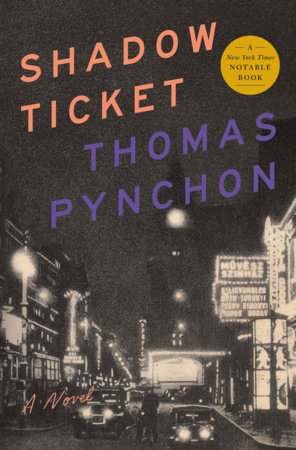 I doubt any library has ever managed to invite him for an author talk. You won’t even find pictures of him, a small miracle in our heavily documented online existence. He was holding out on the release of his books digitally for a long time, too, until 2012. The length and complex page layouts of his novels must have been quite a challenge to convert. I was delighted to locate the new novel in an e-book format from one of our vendors and discover an audiobook version in my public library.
Regardless of mixed reviews I have seen, I decided to read the book anyway, as it was recommended to me by a friend whose opinion I have trusted professionally and personally. The main appeal to me was the plot, placed at the end of the Prohibition-era America, while also taking the protagonist to Hungary. He had me at Prohibition as a historical context, entering into the revival of the drug trade and the redistribution of the market in Chicago. The snob in me also recalls a reading list for a course on the Beat Generation, with Pynchon on the list, along with William Burroughs, Allen Ginsberg, and Jack Kerouac, nothing special in 2026, but quite a feat in communist Hungary in the early 1980s.
Detective and mystery fiction?
Additionally, the book is catalogued under “detective and mystery fiction.” But, of course, we wouldn’t read it just for that, correct? Actually, it is also often labeled as a postmodern detective fiction, a topic that would deserve its own post. For quick comparison, traditional detective stories follow a rather predictable formula: a crime is committed, a detective gathers clues, and the truth is found through logic and deduction. Their world operates like a puzzle: every clue has meaning, every event has a cause, and the mystery ultimately has a solution. Detectives, such as Sherlock Holmes, Hercule Poirot, and Miss Marple, are rational, competent, often infallible characters who manage to sort out the chaos and fit the pieces together. At the end, a clear solution is explained to readers, who, along the way, feel like they are participating in an intellectual game. Chaos gone, order restored.
Upending this formula, in postmodern detective fiction readers find themselves in a chaos, toppled with a lot of ambiguity, misfits, and unsolved mysteries. Emerging in the mid‑20th century and shaped by thinkers who questioned objectivity and absolute truth, postmodern mysteries suggest that evidence can be irrelevant or misleading, narrators unreliable, and solutions impossible. Often confused or unhinged, the incompetent, unmotivated detective follows clues only to discover that meanings multiply rather than converge. Instead of restoring order, the investigations often collapse.
A satire of the absurdity of politics?
With all that in mind, these books are so much fun to read. A true Pynchonesque book, Shadow ticket is impossible to summarize in a neat paragraph. Simply put, the plot follows the adventures of Hicks McTaggart, a Milwaukee private investigator to Hungary as he’s tracking a Wisconsin cheese heiress, who ran away with a jazz clarinet player. Needless to say, one can expect a satire aimed at the absurdity of politics and corruption, hidden in cheese. The protagonist is after the missing cheese heiress, the daughter of the “Al Capone di formaggio” in the book, and the story will turn rather “cheesy” sometimes: cheese has emotions, radioactive cheese is framed as the secret of family romance, there’s cheese fraud and cheese syndicate. The cheese-based colonialist powers cause cheeselessness in Asia, and mentioning the Rockfort police and Gorgonzola squad cracks up the reader unexpectedly.
Side note: if anyone is wondering about hints to current political trends, I challenge the reader with this quote: “Republicans and gangsters? How can such a thing be?” (p. 135).
Reading for the language
I got fascinated by the versatility of the period language in the book, perfectly mirroring the chaos, characters, situations, professions, locations, cultures, and subcultures on both sides of the pond, from Prohibition in Milwaukee in 1932 to the post-Trianon Hungary and Central Europe, whether in Friedrichstraße in Berlin or Vörösmarty tér in Budapest. A “ticket,” in a detective agency at the time, refers to an assignment or case, with “shadow” referring to the off-the-books nature. The word “prohis” was a slang term for federal Prohibition agents, enforcing the ban on alcohol during the Prohibition era (1920–1933), sometimes also called “drys” after the “The Drys” political and social movement that supported Prohibition. Drinks and booze serve to set the scene from “The Doc Holliday” martinis to Mistletoe gin, Champagne Cocktails, and Sidecars to the famous Hungarian Unicum.
Like a good postmodern novel, Shadow ticket will expand your vocabulary and general knowledge if you admit your gaps. I found out that a “black-and-tan” was a nightclub in the US that welcomed people of all races (despite segregation laws) in the early 20th century. An “autogyro” (or gyroplane) is a rotary-wing aircraft, invented by a Spanish engineer in 1923. Some of these already border the absurd, such as the U-13 Hungarian submarine turning up in Chicago, but it actually was an Austro-Hungarian Navy submarine active during World War. It reminds me of György Moldova’s fictional “pocket cruiser,” in a satirical short store yet to be translated into English. Others are likely fictional, such as the Trans-Trianon 2000 motorcycle ride through the disputed territories of Central Europe. Narrators in postmodern novels are often unreliable, making it difficult for the reader to discern fact from fiction.
A work of fiction?
References to actual historical figures and events, such as Sacco and Vanzetti, the Lindbergh baby, or the Haymarket bomb frame-up will sound familiar to the American reader, who will probably not get the reference to Karlsbad with its Czech name at that time, Karlovy Vary. Neither would Motalko ring the bell, which is the fuel mix recently presented by a documentary about the Hungarian gas station selling this alternative to gasoline. I loved the reference to the Hungarian-born inventor of krav maga, Imi Lichtenfeld, who laid the foundation of the Israeli martial art to defend his neigbourhood, the Jewish quarter with practical self-defense techniques against fascist gangs in Bratislava (or Pozsony, as it used to be Hungarian territory) in Slovakia.
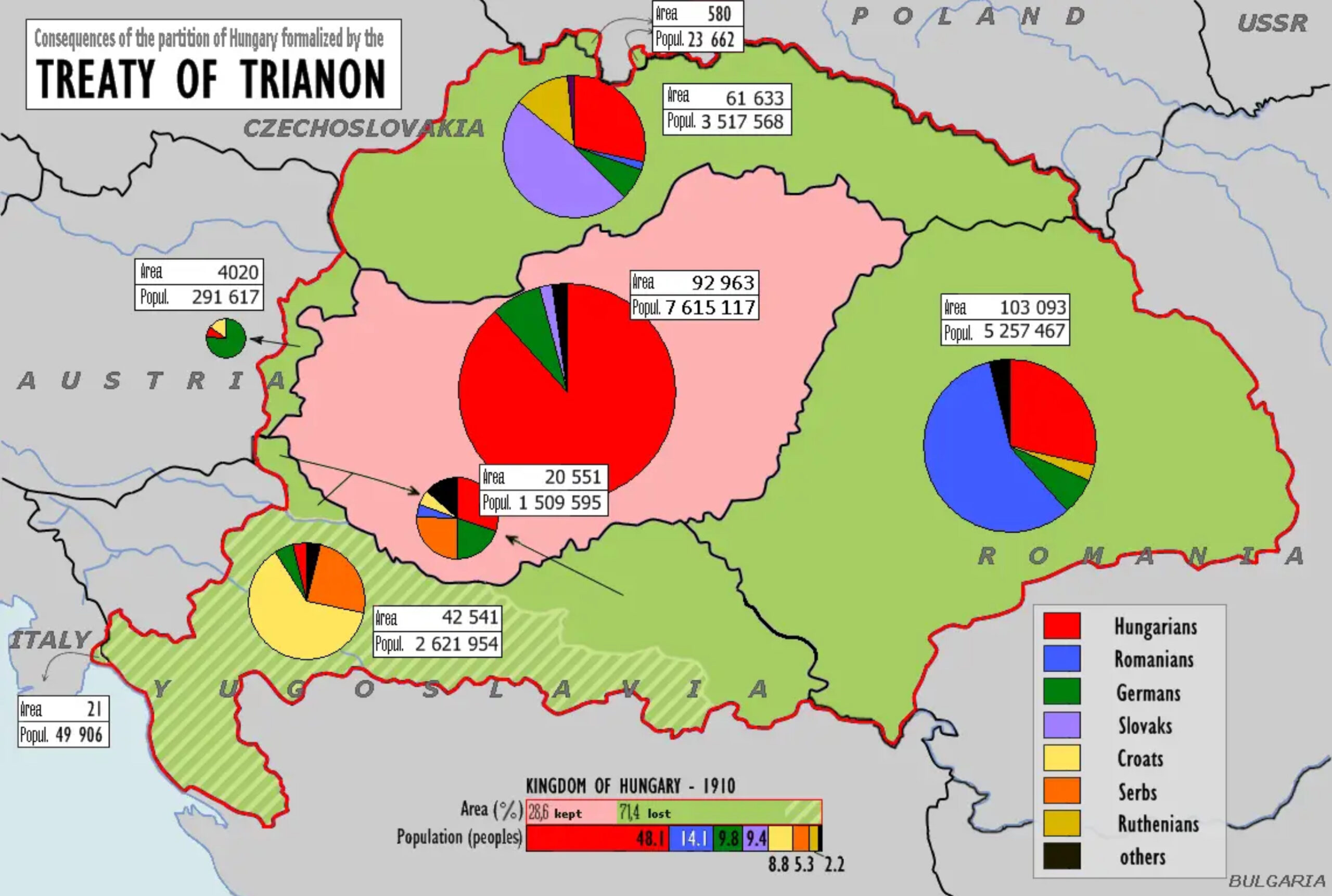 Musical references span Puccini operas, such as Madama Butterfly, La bohème and Gianni Schicchi; Klezmer and jazz; saxophones and theremin (a touchless electronic instrument) and even the Székely Anthem. So fitting to the geopolitics: Hungary lost two-thirds of its territories after World War II as stipulated by the Treaty of Trianon, among them Transylvania with the Székely, who, becoming an ethnic group in Romania, have been yearning after the motherland ever since.
The least expected reference mentions (Szilveszter) Matuska, who blew up the Vienna Express in 1931 in Biatorbágy, Hungary, a fact that every Hungarian kid learns in middle school. The tip of the iceberg, language and facts show incredible research behind the story.
Insult is poetry in Hungary
Circling back to language, the mirror translations of current American idiomas are most amusing, such as the Italian “bel lavoro” (good job), “lascia perdere” (fuhgeddaboudit), “porca miseria” (holy cow – literally, pig), or German “kleine kartofel” (small potatoes), let alone other all-purpose profanities in multiple languages, including my native Hungarian, in which “insult is poetry” (p. 186), claims the book. Modesty and self-censorship prevents me from continuing this quote or presenting others, but those who know me will attest that I’m capable and willing to authenticate any of them!
All in all, it was a gread read. Thanks, Bill, for the recommendation!