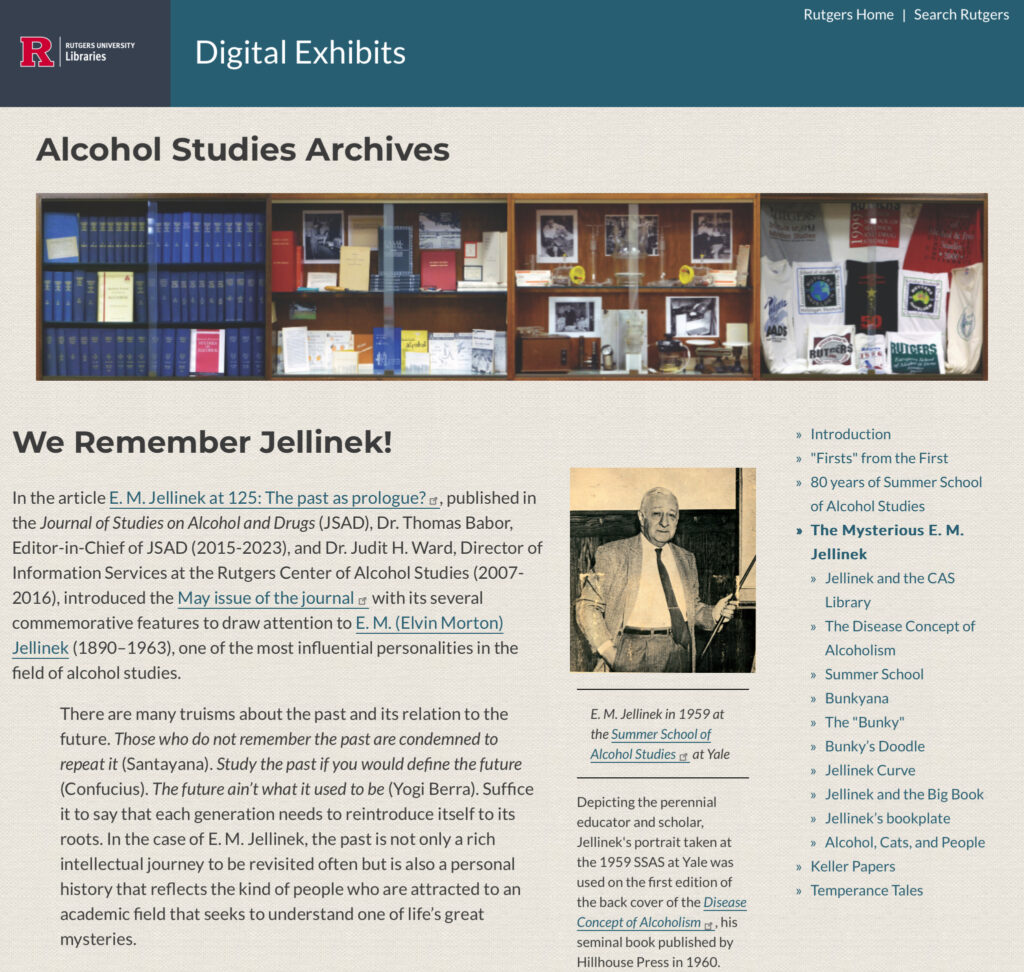
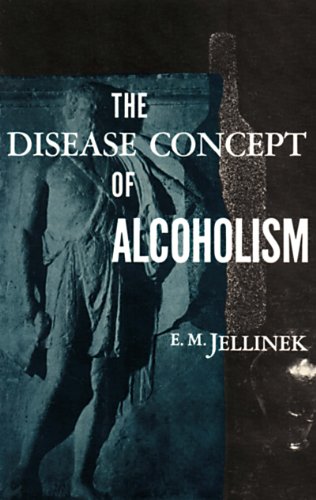
 The disease concept of alcoholism stands as “the most widely cited (and least read) literary artifact of the modern alcoholism movement,” according to alcohol historian William White. Published in 1960 by Hillhouse Press, the publisher of the Yale Center of Alcohol Studies on behalf of the Christopher D. Smithers Foundation, E. M. Jellinek‘s seminal book has been cited 4,720 times (Google Scholar, July 28, 2025). Whether writing about etiology, treatment, prevention, or language related to alcohol and substance use disorder, it is not the book that one cannot ignore. Although articles citing the book span from harsh criticism to unconditional approval in the scholarly literature and beyond, the English language has also cast its vote, calling alcoholism the “Jellinek disease.” Leaving all that to more qualified researchers, this post focuses on facts about the book documented in the Rutgers Digital Alcohol Studies Archives.
Who was Jellinek?
Elvin Morton (E. M.) Jellinek (1890–1963) has been described as “the Renaissance Man who brought alcohol studies out of the Dark Ages” by Dr. Thomas Babor, Editor-in-Chief of the Journal of Studies on Alcohol and Drugs (JSAD, 2015-2023), the 2005 recipient of the Jellinek Memorial Award, the most prestigious recognition in alcohol studies. It includes a “Bunky,” Jellinek’s bust, cast in bronze, memorializing E. M. Jellinek’s preferred nickname.
Jellinek’s contributions laid the foundation for how alcoholism is understood and treated today. His legacy includes his “phases of progression of alcoholism,” the four phases every person with alcohol use disorder experiences, which evolved into a staple educational tool at treatment centers, popularly referred to as the ”Jellinek Curve.” Named after Jellinek out of respect, the curve-shaped chart was actually created by British physician Max Glatt, who added an upswing recovery segment to Jellinek’s “phases of alcoholism.”
Jellinek influenced generations with his intellect, curiosity, and dedication. He was just as interested in linguistics, anthropology, and mythology as he was in statistics or psychiatry. He brought this broad perspective into every discussion, encouraging interdisciplinary research long before it became fashionable. His global outlook was not just academic—it was personal and practical. Fluent in several languages and familiar with diverse cultures, Jellinek managed to bring international perspectives into the study of alcoholism.

Highlighting Jellinek’s work at the SALIS conference in 2014 at Rutgers, which became the source of our contributions to the Wikipedia entry about Jellinek.
Copyright
The copyright registration attributes The disease concept of alcoholism by E. M. Jellinek to Hillhouse Press with the address 432 Temple Street, New Haven, CT. The publisher of many publications of the Quarterly Journal of Studies on Alcohol at the Yale Center of Alcohol Studies (after several name changes), it still publishes the longest running scholarly journal in addiction studies. Known today as the Journal of Studies on Alcohol and Drugs, a nonprofit published at the Rutgers Center of Alcohol and Substance Use Studies by Alcohol Research Documentation, Inc. A promotional flyer shows that the book was available from the Publications Division of the Rutgers Center of Alcohol Studies after the Center moved from Yale to Rutgers in 1962.
Language
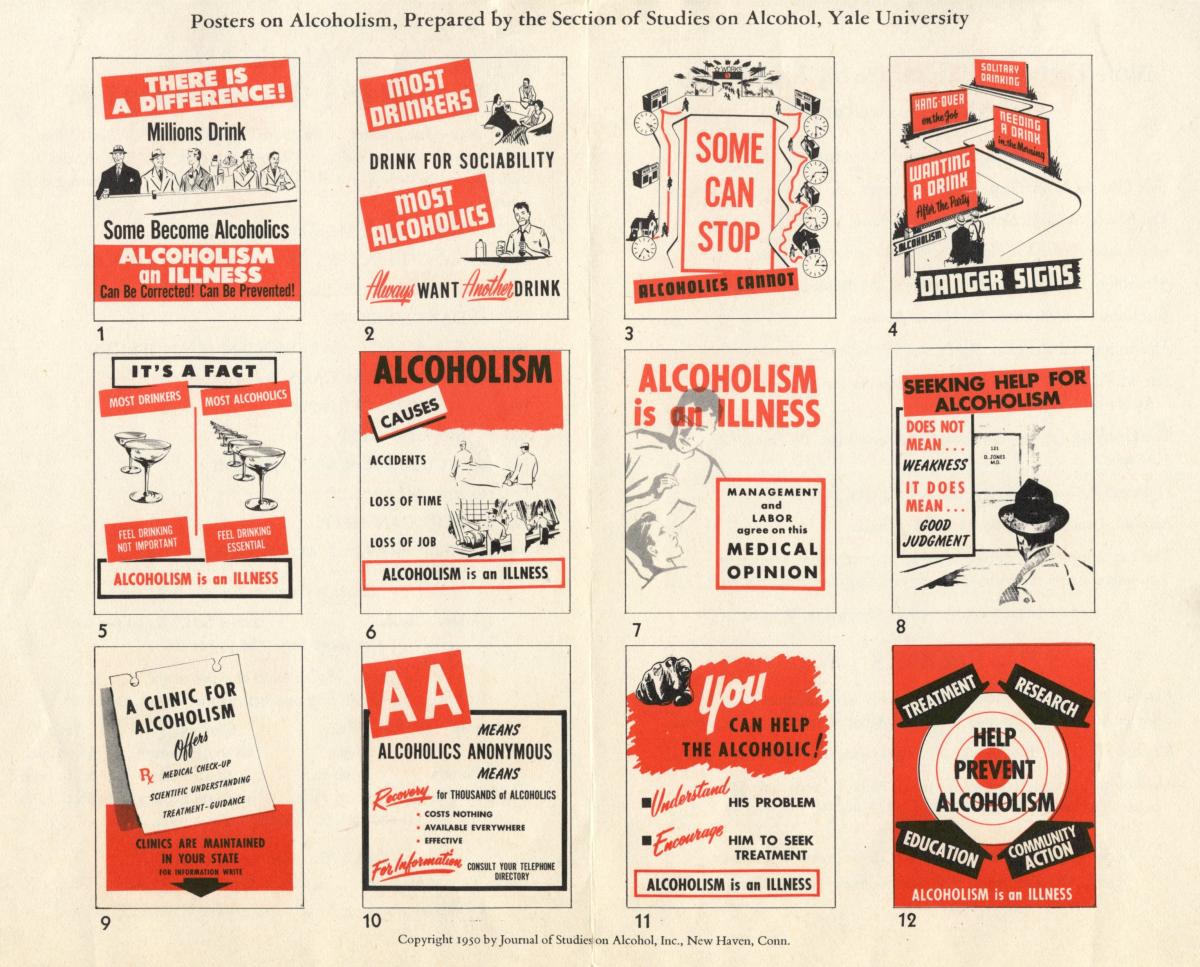
In addition to the Yale Plan Clinic posters declaring alcoholism a disease in 1950, the title of Jellinek’s book, changing from “conception” to “concept” shown by our documents, made a significant contribution to the public acceptance of alcoholism as a disease – regardless of whether Jellinek’s book should receive credit. It’s a case similar to what was pointed out by Ernest Kurtz in Alcoholics Anonymous and the Disease Concept of Alcoholism, i.e., that A.A. neither originated nor promulgated the disease concept of alcoholism. However, Jellinek and his colleagues at Yale were pioneers dedicated to creating a vocabulary for alcohol research, including the definition of alcoholism. In his own words, Jellinek states in the Introduction:
Alcoholism is a concept, so is disease. But that alcoholism is a disease is a viewpoint and thus a conception. Nevertheless, I have bowed to the prevalent usage.
Correspondence
In a letter dated February 25, 1959, Mark Keller writes to Brinkley Smithers that he visited Jellinek in Toronto to work with him on the manuscript. Keller shares two more estimates for the publication costs. The original figure for 2,000 copies was over $7,000 and another $1,300 for an additional thousand copies. The new cost would be $4,665.35 for 2,500 copies. Jellinek suggested that they should print 3,000 copies: the additional 500 copies will cost only $483. In the same letter, Keller also notifies Smithers that Bunky finally agreed to call the book simply the “Disease concept of alcoholism,” rather than “conception,” because this has “more punch than any other considered before.”
In a letter dated November 4, 1960 that Jellinek sent to editor Mark Keller, the author expresses his satisfaction with the publication, calling it “handsome” and suggests promotion ideas in the hope of successful sales. From the letter we can find out that his honorarium was $300, which “came in very very handy.” It saddens the 21st-century reader to read that one of the greatest minds in alcohol studies was facing financial difficulties in the last few years of his career.
- Read more on related and official correspondence
Disease Concept published
The book was published by Hillhouse Press in 1960, then republished and distributed with the scholarly backup of the Yale and Rutgers Centers of Alcohol Studies (CAS) in 1962, 1972, and 1979. Later editions, unrelated to CAS, offer more print and electronic options, targeting broad audiences. The first edition, painstakingly edited by the one and only Mark Keller, is available online in the SALIS collection of the Internet Archive, a resource with over 8,000 titles on alcohol, tobacco, and other drugs to view or borrow.
Explore We Remember Jellinek!
As a humble chronicler and recorder of the history of alcohol studies, I have recently completed the exhibit We Remember Jellinek! as part of the Digital Alcohol Studies Archives, a larger project that shares unique resources amassed at the Yale and Rutgers Centers of Alcohol Studies over the past eighty years. The Rutgers Center has been a vital part of the field’s history and a crucial institutional repository for preserving and disseminating that history, dating back to its inaugural survey of scientific literature on alcohol in 1940, led by E. M Jellinek.
The Alcohol Studies Collection at Rutgers pays tribute to many pioneers in the field, but few loom as large as Elvin Morton Jellinek. The Jellinek exhibit adds key components to a yet-to-be-written Jellinek-biography. In addition to the “Bunkyana,” as we, the curators, call any artifact related to “Bunky,” the exhibit presents an engaging collection of personal stories, giving life to the man behind the monumental ideas through the lens of his peers as well as CAS Library staff, who recently contributed to the Jellinek research.
Whether you are a scholar, student, or simply someone interested in the human side of scientific progress, our tribute to E.M. Jellinek offers valuable insights—and inspiration. Explore We Remember Jellinek! to meet the man behind the science—through the eyes of those who knew him best.
*This post was written using content from my earlier Jellinek-related posts on the Alcohol Studies Archive blog. All opinions and updates shared in the blog are solely those of the author.
References
- Bejarano, W. (2015). Language matters: Terminology in the scientific alcohol literature. Substance Abuse Library and Information Studies, 2, 39-45.
- Jellinek, E. M. (Elvin M.) (1960). The disease concept of alcoholism. Hillhouse Press.
- Letter from Mark Keller to Brinkley Smithers. February 25, 1959. Mark Keller Papers. Digital Alcohol Studies Archives. Rutgers University Libraries.
- Letter from E. M. Jellinek to Mark Keller. November 4, 1960. Mark Keller Papers. Digital Alcohol Studies Archives. Rutgers University Libraries.
- Kurtz, E.(2002). Alcoholics Anonymous and the Disease Concept of Alcoholism, Alcoholism Treatment Quarterly, 20(3-4),5-39.
- SALIS Collection.
- Ward, J. H., Bejarano, W., Babor, T. F., & Allred, N. (2016). Re-introducing Bunky at 125: E. M. Jellinek’s life and contributions to alcohol studies. Journal of Studies on Alcohol and Drugs, 77, 375–383.
- White, W. (2000). Addiction as a disease: Birth of a concept. Counselor, 1(1), 46-51, 73.